
In Space Humanity Deserves Better Than a Liquid Battery
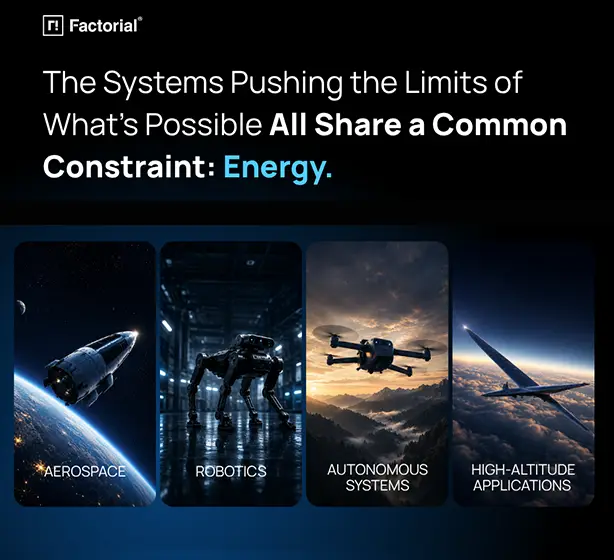
In the orbital economy, every gram is a negotiation. In a vacuum, every liquid is a liability.
Every kilogram added to an aerial platform reduces payload. Every thermal management system adds complexity. Every limitation on operating range constrains what a mission can accomplish. Every thermal runaway risks mission failure. These are not abstract engineering concerns. They are the constraints that define the outer edge of what advanced autonomous systems, robotics, and aerospace platforms can actually do.
And for years, one limiting factor has been the same: the battery.
Conventional lithium-ion batteries have served the industry well. But they were designed for a different era; one where electric vehicles were the primary use case and the performance envelope was defined by consumer expectations rather than the demands of autonomous flight, remote operations, and next-generation space infrastructure.
The markets that matter most today have moved beyond what liquid-electrolyte architectures were ever built to handle.
A Different Kind of Problem
Space is hostile to liquids. The same electrolyte that makes a conventional lithium-ion battery function, a carefully formulated liquid chemistry sealed inside a cell, becomes a liability the moment it leaves Earth’s atmosphere. In the vacuum of space, liquid electrolytes outgas. Seals that held perfectly on the ground fail under pressure differentials and thermal cycling. A leak too small to detect at manufacture quietly bleeds the battery of its capacity over months, then years. In microgravity, there is no convection to redistribute heat, no gravity to keep electrolyte where it belongs – localized hotspots build, pressure accumulates unevenly, and what begins as a hairline seal failure can end in rupture. Of more than 250 known satellite explosions in orbit, roughly 10 have been attributed to batteries1. For every mission that succeeded despite battery degradation, there were performance margins quietly sacrificed, range shortened, compute throttled, payloads reduced. Liquid electrolyte batteries were engineered for a world with air, gravity, and ground crews. Space has none of those. Future designs can add redundancy and protection mechanisms. But every mitigation carries its own cost in mass, complexity, and dollars. None of them fix what’s underneath.
Heat compounds the problem. Conventional lithium-ion batteries require active cooling above 45°C, a threshold that aerospace platforms routinely exceed during high compute operations, sustained discharge, or simply absorbing solar load in orbit. On Earth, cooling systems are an inconvenience. On an aerial platform, a satellite, or an autonomous system operating at the edge of its design envelope, they are mass, volume, and complexity that cannot always be accommodated. Every thermal management system added to protect a battery is weight that didn’t go to payload, space that didn’t go to sensors, and a failure mode that didn’t need to exist. The battery was supposed to power the mission. Instead, it is dictating its constraints.
SolsticeTM Changes the Equation
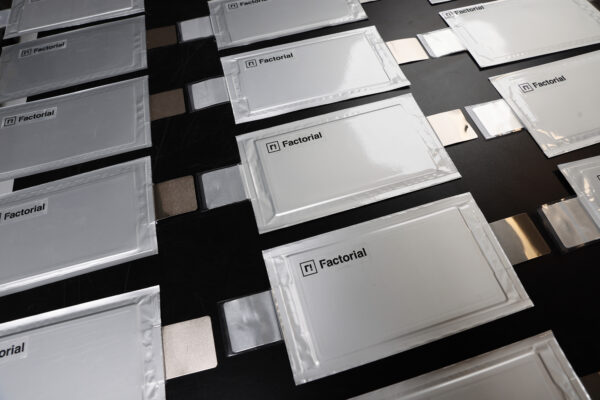
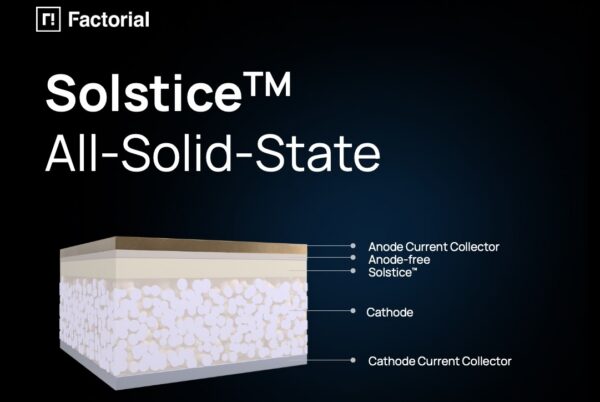
Factorial built Solstice™ to eliminate the problem at its source. Solstice is an all-solid-state battery platform built on a zero-liquid, sulfide-based solid electrolyte architecture. Replacing liquid electrolytes with solid materials isn’t an incremental refinement; it eliminates the fundamental vulnerabilities that make conventional batteries poorly suited to the most demanding environments these industries operate in.
Unlike liquid electrolytes, the sulfide solid electrolyte does not evaporate, does not migrate, and generates no vapor pressure — eliminating the containment requirements incompatible with vacuum, thermal extremes, and the mechanical stresses of launch and sustained operation. Under normal conditions, when processed and sealed under dry conditions, the cell is designed to be stable across temperatures, vacuum, and launch vibration for space applications
Thermal stability changes the equation further. Solstice™ cells can operate at temperatures of 90°C without needs for cooling. The threshold that forces conventional batteries into elaborate thermal management architectures is simply not a constraint. No cooling loops. No heat exchangers. No mass penalty paid to protect a chemistry that was never designed for the environment in the first place. What that mass and volume recover goes back to the mission – more payload, more sensors, more range, more endurance.
Solid-state cells can also achieve significantly higher energy density, more energy in less mass and volume, which directly expands what a platform can carry, how far it can travel, and how long it can operate. For orbital platforms where every gram and every watt-hour is a design decision, solid-state isn’t an incremental improvement. It’s a different set of constraints entirely.
For future orbital systems, where every kilogram of mass carries enormous cost, the calculus becomes even more compelling.
Why Now
The timing matters. Investment in space and orbital system is accelerating, and energy storage is moving from a supporting component to a strategic differentiator. The organizations building the next generation of platforms are making architectural decisions today that will define what those systems can accomplish for years.
Factorial’s foundation in automotive runs deep, including multi-year development programs with Mercedes-Benz, Stellantis, Hyundai, and Kia that pushed solid-state battery technology to the edge of what’s possible under real-world performance and thermal stability requirements. That foundation translates directly to space and orbital systems. The underlying physics are the same. The demands are, in many cases, more extreme.
The question for developers across aerospace, robotics, and AI infrastructure – the new growth frontiers of the next decade – isn’t whether energy storage matters. It’s whether their energy storage partner is ready for what comes next.
Factorial is.
Forward-Looking Statements
Certain statements in this communication may be considered “forward-looking statements.” Forward-looking statements herein generally relate to future events or the future financial or operating performance of Factorial Energy Inc. In some cases, you can identify forward-looking statements by terminology such as “may,” “should,” “expect,” “intend,” “will,” “estimate,” “anticipate,” “believe,” “predict,” “project,” “target,” “plan,” “potentially,” or the negatives of these terms or variations of them or similar terminology. Such forward-looking statements are subject to risks, uncertainties, and other factors which could cause actual results to differ materially from those expressed or implied by such forward-looking statements. While Factorial may elect to update such forward-looking statements in the future, it disclaims any obligation to do so.