

Solid-State Battery Chemistries Decoded
Solid-state batteries are one of the most talked about technologies in energy right now, and they raise many questions: what they are, how they work, and what impact they have on the systems that power mobility, robotics, aerospace, and AI infrastructure. Even the term itself is only vaguely defined. It can describe a cell with some liquid, in this case called quasi-solid-state, or a cell with absolutely zero liquid, sometimes labeled “all-solid-state” for emphasis. The difference comes down to the type of electrolyte, the layer that carries lithium ions between the electrodes.
As we spend much of our time with automakers, partners in aerospace and other industries, as well as with investors, one question keeps coming up: some version of “which chemistry wins?” The unsatisfying answer is that it depends on what you are building and how it is going to operate.
Below, we walk through the main approaches in plain terms, why manufacturing matters as much as chemistry, and where Factorial fits.
What is a solid-state battery and why does it matter?
A solid-state battery replaces some or all of the liquid electrolyte in a conventional lithium-ion cell with a solid or quasi-solid material. The main reason to make that change is higher energy density, which means a smaller, lighter, more powerful battery without sacrificing safety. In practice, that means longer range for vehicles, more payload and endurance for aircraft, and longer run time for robots and other intelligent machines. Aerospace, defense, robotics, and AI hardware all run into the same limit: how much energy you can safely carry for a given weight. Solid-state cells are designed to raise that limit.
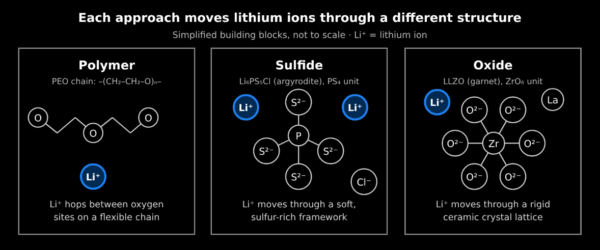
Most solid-state approaches fall into three families, each named for its electrolyte material. Each makes a different trade-off between performance and how hard it is to manufacture.
Chemistry | Details | Key Strengths |
Polymer and quasi-solid | Polymer electrolytes use organic polymer matrices, including polyethylene oxide, or PEO, to conduct lithium ions. Polymer-composite and quasi-solid systems combine those matrices with ceramic particles or other fillers to improve conductivity and mechanical behavior. | Works with much of today’s lithium-ion manufacturing |
Sulfide | Sulfide electrolytes are lithium-ion conductors based on sulfur-containing compounds, including argyrodite-type material. They are widely studied for high room-temperature ionic conductivity and mechanical compliance. | High ionic conductivity, compressable at room temperature
|
Oxide | Oxide electrolytes include garnet-type material and are known for strong thermal stability, broad electrochemical stability windows, and chemical resilience in ambient conditions.[2] In production, oxides are rigid and usually need high-temperature sintering, which makes thin, large-format layers hard to produce at volume. | Very stable under heat and in open air |
The right choice depends on the application and the path to producing it at scale.
What other solid-state electrolyte approaches are emerging?
Beyond polymer, sulfide, and oxide systems, a few other electrolyte approaches are worth knowing. Some are earlier in development, and some suit narrower uses.
Thin-film ceramics
Thin-film ceramic electrolytes use vacuum-deposited oxide or sulfide layers. They can perform well in small-format cells, but vacuum deposition is slow, which makes larger cells hard to produce at volume.
Composite electrolytes
Halide electrolytes, including materials such as Li₃YCl₆, are an emerging class of solid electrolytes with promising oxidative stability, which matters when pairing them with high-voltage cathodes. Researchers are still evaluating their conductivity, cathode compatibility, and production pathways.
Halide electrolytes
Composite electrolytes blend ceramic particles with polymer matrices. The goal is to keep the processability and flexibility of polymers while adding some of the conductivity, thermal, and mechanical benefits of ceramics.
How do the major solid-state electrolyte chemistries compare?
When we look at a chemistry, we ask how its material properties carry through to the performance of a complete solid-state cell, and how readily that cell can be produced at scale. In our experience, five factors matter most:
Conductivity: Higher room-temperature conductivity lets a cell deliver power without added heating.
Mechanical Properties: Electrodes swell and shrink as a battery charges and discharges. Flexible electrolytes keep contact more easily, while rigid ones need careful cell design, and often external pressure, to stay in contact.
Handling and stability: Brittle materials, such as oxide ceramics, can crack during handling, stacking, and cell assembly, which lowers yield and adds cost.
Manufacturing path: Whether a chemistry can run on existing lithium-ion equipment, or needs new lines, environments, and partners, is often the biggest factor in the cost and speed of scaling. The inertia of changing an existing line is high.
Interfaces: Interface design and stability towards electrodes is critical. Careful selection of materials and design of interlayers will determine how long the battery can last.
Property | Polymer / Composite | Sulfide | Oxide |
Room-temperature ionic conductivity | Low to moderate, with improvement possible in composites | High in several compositions | Moderate to high |
Mechanical behavior | Flexible | Soft and compliant | Rigid and brittle |
Air and moisture stability | Generally good | Requires controlled handling | Strong |
Processing temperature | Low | Low to moderate | Often high |
Manufacturing approach | Can align with existing lithium-ion processes | Requires dry-room controls | Requires specialized ceramic processing |
Electrochemical stability | Moderate | Interface engineering can be required | Broad stability window |
The best electrolyte choice follows the application and the path to commercialization. Energy-density targets, operating temperature, cell architecture, interface design, manufacturing infrastructure, yield, and cost all shape that decision.
How does Factorial approach solid-state battery chemistry?
At Factorial, we develop two battery platforms because our customers need different things. Automakers, aerospace partners, and developers of intelligent systems each weigh energy density, operating conditions, and manufacturing path differently.
FEST®: quasi-solid-state battery platform
FEST® is our quasi-solid-state battery platform, built around a quasi-solid polymer electrolyte and designed to work with a variety of anode materials. We designed its production process to be compatible with up to 80% of existing lithium-ion manufacturing equipment. [Factorial Energy]
That matters to automakers. When we talk with OEMs about scale, an early question is how much of their existing equipment, process knowledge, and supply chain they can keep using. FEST® is designed to keep more of it in use. We have taken FEST® through automotive development and road-testing programs, including our 77 Ah cells verified by Stellantis at 375 Wh/kg.
Solstice™: zero-liquid, sulfide-based all-solid-state platform
Solstice™ is our all-solid-state battery platform, built on a zero-liquid, sulfide-based solid electrolyte architecture. Its dry-cathode process is designed to reduce the use of organic solvents and the energy-intensive drying that comes with them.
Solstice™ is aimed at applications where high energy and thermal robustness come first, including aerospace and other advanced mobility.
How should you evaluate a solid-state battery technology?
When you evaluate a solid-state battery technology, look past the headline energy-density number. A coin cell in a lab shows the chemistry can work. A large-format cell, tested under realistic conditions and built on a repeatable process, tells you much more about whether it can reach a vehicle or an aircraft. These are the questions automakers and aerospace partners ask us, and the ones we would ask in their seat:
Evaluation dimension | Question to ask | Why it matters |
Energy density | What cell format, capacity, and test conditions produced the reported value? | A coin-cell result differs materially from a large-format, production-representative cell. |
Manufacturability | What existing infrastructure can the process use? | Equipment compatibility affects capital requirements, timeline, and manufacturing risk. |
Scalability evidence | What is the largest cell demonstrated, and at what yield? | Laboratory performance must translate into repeatable production. |
Customer validation | Have OEMs or end customers tested the cells in real-world programs? | A customer testing cells in its own system is an independent check on the claims. |
Chemistry trade-offs | Which limitations are known, and how are they being addressed? | A developer should be able to say what is still unsolved and how it plans to solve it. |
Some of our own milestones are public. Our commercial aerospace order announcement covers the move from battery integration and flight testing into commercial aerospace applications. Our memorandum of understanding with SK On addresses manufacturing feasibility, specifically whether FEST® can be built using SK On’s existing lithium-ion production infrastructure.
Frequently asked questions
Is one solid-state battery chemistry better than the others?
No single chemistry is best for every application. Polymer-composite systems fit more easily into existing manufacturing and stay mechanically flexible. Sulfide systems conduct lithium ions well at room temperature. Oxide systems are chemically and thermally stable. Which of these matters most depends on the cell design, the application, and how the cell will be manufactured.
Why do battery companies choose polymer, sulfide, or oxide electrolytes?
It comes down to what the platform needs to deliver and how it will be built. Polymer and quasi-solid systems work with familiar manufacturing methods. Sulfide systems make thermally robust, all-solid-state cells possible. Oxide systems bring chemical stability. Each approach needs its own interface and process engineering.
Can solid-state batteries use existing lithium-ion manufacturing equipment?
Some can keep a large share of today’s lithium-ion equipment. Polymer and quasi-solid composite systems sit closest to familiar coating and lamination processes. Our FEST platform, for example, is designed to be compatible with up to 80% of existing lithium-ion manufacturing equipment. Sulfide systems need dry-room conditions because the materials react with moisture. Oxide systems often require specialized ceramic processing and high-temperature sintering.
What should I look for when comparing solid-state battery companies?
Read every performance claim next to the scale it was shown at. The things we look at are cell format and capacity, test conditions, manufacturing yield, customer validation, production-equipment strategy, and how openly a company talks about what is still unsolved. For a fair comparison, match cell formats and capacity, development stages, and operating conditions.
Forward-Looking Statements
Certain statements in this communication may be considered “forward-looking statements.” Forward-looking statements herein generally relate to future events or the future financial or operating performance of Factorial Energy Inc. In some cases, you can identify forward-looking statements by terminology such as “may,” “should,” “expect,” “intend,” “will,” “estimate,” “anticipate,” “believe,” “predict,” “project,” “target,” “plan,” “potentially,” or the negatives of these terms or variations of them or similar terminology. Such forward-looking statements are subject to risks, uncertainties, and other factors which could cause actual results to differ materially from those expressed or implied by such forward-looking statements. While Factorial may elect to update such forward-looking statements in the future, it disclaims any obligation to do so.
